The history of ube
How did a purple yam from the Philippines become a global coffee-shop star? Here is the journey of ube, from family kitchens to social media, by way of the Filipino diaspora.
An old Filipino tradition
Long before becoming trendy, ube was an everyday food in the Philippines. It appeared in family desserts, often as ube halaya, a slow-cooked yam jam, and in a host of sweets shared during celebrations. There, ube has always been a byword for indulgence and togetherness.
Ube has been part of Filipino culinary heritage for generations. Its purple colour naturally made it a star of festive tables.
The diaspora, a carrier of taste
It was largely thanks to the Filipino diaspora that ube travelled. Settling notably in the United States, Filipino communities brought their recipes, and ube gradually won people over beyond the family kitchen. Purple pastries, ice creams and donuts began to appear in American shop windows.
The history of ube is also a story of passing on: that of a shared culinary heritage, which crossed borders along with families.
Social media and coffee shops
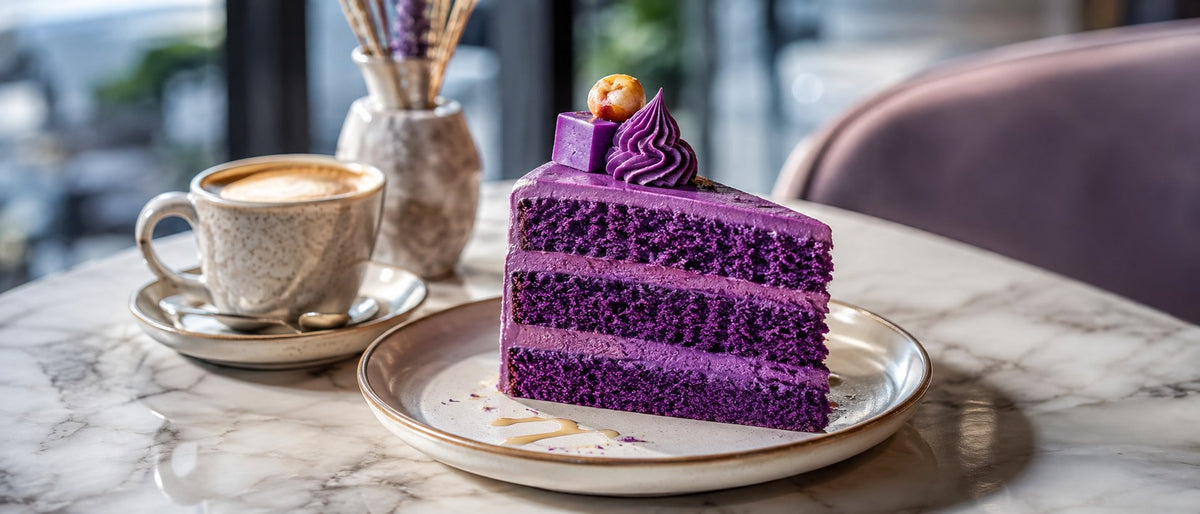
The real turning point came from the image. With its spectacular purple colour, ube was made for social media. Endlessly photogenic, it flooded feeds, carried by the coffee shops that turned it into irresistible lattes and pastries. The ube latte thus became a visual icon as much as a flavour one.
If ube first drew you in with its colour, let its taste surprise you: a vanilla-nutty sweetness that also explains its success.
And today, in Europe
After Asia and America, ube is arriving in Europe. Long hard to find, it is becoming more widely available thanks to the powder, which finally makes it easy to cook at home. From a curiosity, ube is becoming an ingredient adopted for good.
- A traditional Philippine food, notably through ube halaya.
- Spread by the diaspora, first in the United States.
- Went viral thanks to its colour and to coffee shops.
- Now accessible in Europe, mainly thanks to the powder.
See the origins of ube, the complete ube guide, or the ube latte recipe.
A history, in your cup.
With our 100% Kinampay ube powder, you carry on at home a history born in the Philippines. The taste of a heritage, with added simplicity.
Your questions: the history of ube.
Where does ube's popularity come from?
From an old Filipino culinary tradition, spread by the diaspora, then made viral by its purple colour on social media and in coffee shops.
How long have people eaten ube?
For generations in the Philippines, where it is part of family and festive desserts, notably as ube halaya.
How did ube reach the West?
Largely thanks to the Filipino diaspora, notably in the United States, then through social media and the coffee shops that popularised it.
Why did ube go viral?
Thanks to its spectacular purple colour, very photogenic, perfect for social media, and a sweet taste that won people over beyond the image.
Is ube easy to find in Europe?
Increasingly so, mainly thanks to the powder, which lets you cook ube at home without having to find the fresh tuber.