Why Is Ube Purple?
It's the first thing that strikes you: that intense, almost unreal purple. Yet ube owes its colour to no dye. Only to nature.
Here's the simple, fascinating science behind the most photogenic colour in your cup.
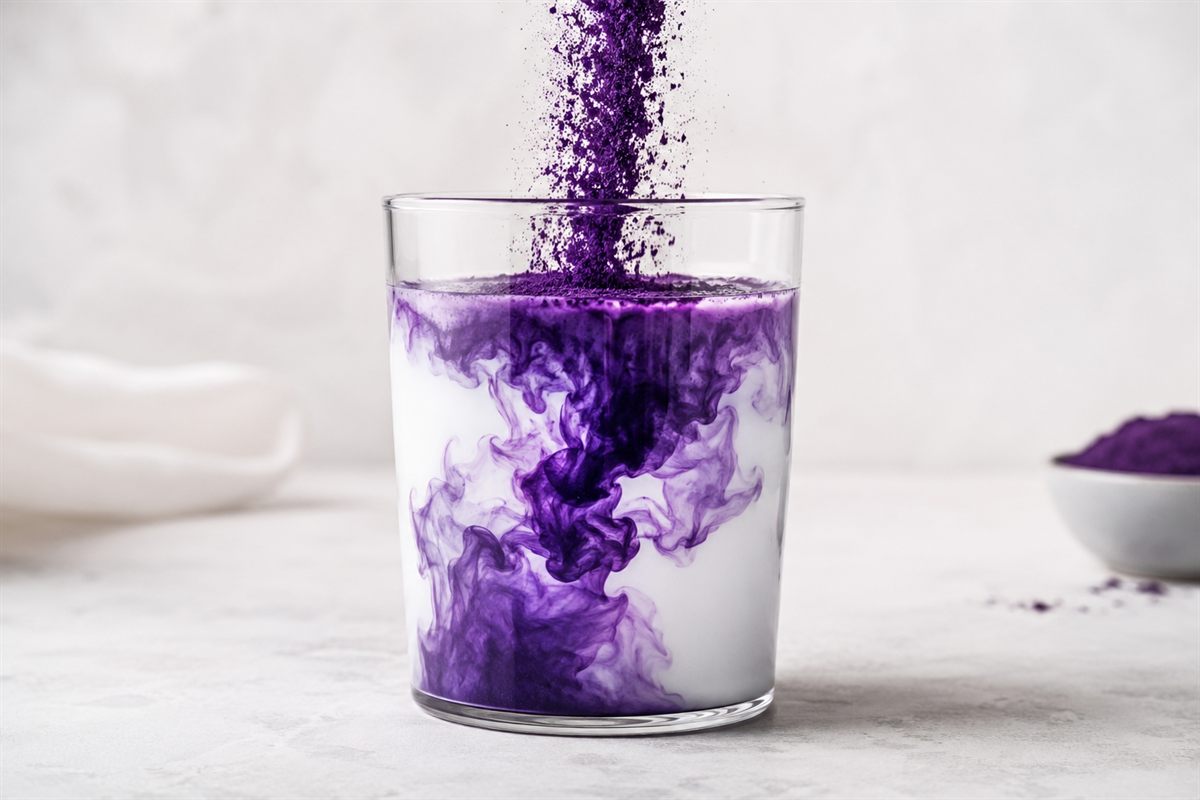
The secret comes down to one word: anthocyanins
Ube's purple comes from natural pigments called anthocyanins.
These are molecules produced by the plant itself, from the flavonoid family. In nature, they're what tint a multitude of fruits and vegetables red, blue or purple.
Kinampay is particularly rich in them: that's what explains its deep colour, where other yams stay pale.
No dye, no additive. Ube's purple is entirely produced by the plant. A colour that grew in the soil, not in a lab.
A purple that shifts hue
Here's the fascinating part.
Anthocyanins are sensitive to acidity. Depending on what you add, they can turn slightly towards pink, mauve or blue. A dash of lemon, a more or less neutral milk, and the shade evolves.
That's why ube's colour is never quite the same twice. It's not a flaw: it's a signature.
Anthocyanins act as natural pH indicators. The same pigments that colour ube change hue with acidity, like a little edible chemistry experiment.
 Nature's pigments
The same pigments as the blueberry
Ube is in good company.
Anthocyanins aren't unique to it. They're found in blueberry, blackberry, black grape, red cabbage and even black rice.
Each time, the same magic: an intense colour, born of the plant, without the slightest artifice.
Natural colour or dye: the real difference
Many purple products owe their shade to added dyes. Ube colours itself.
That's the whole difference between a colour made in a lab and a colour that grew in the soil. The first is always identical; the second lives, breathes, varies slightly. That's its charm.
A purple that's too vivid, almost neon, should raise suspicion: nature always stays a little softer.
For a vibrant purple in your recipes, dissolve the powder in a little hot liquid before mixing it in. The colour is fully released.
 A 100% plant-based purple
A purple that nothing imitates.
It's its identity card.
You recognise that deep purple among a thousand. It's softer, more alive than artificial dyes, often more vivid but soulless.
In a preparation, a touch of ube is enough to transform everything.
A colour you can cook with
In a latte, an ice cream or a cake, ube colours effortlessly and with no chemical aftertaste.
Its shade holds well in the preparation, even if it can shift slightly depending on the ingredients. The purple becomes indulgent, and each recipe takes on the look of a little work of art.
Getting the most beautiful purple
A few simple steps are enough to achieve a vibrant colour.
Dissolve first: mix the powder in a little hot liquid — the colour is fully released. Dose to the intensity you want: more powder, more purple. Avoid excess acidity if you prefer a deep mauve to a pinker tone.
- Ube's purple is 100% natural, due to anthocyanins.
- It can vary slightly with acidity: that's normal.
- Dissolved and well dosed, it gives a spectacular colour to all your recipes.
Want to know it all? What is ube? And on taste: ube or matcha.
See that purple with your own eyes?
Nothing beats a first cup of ube. To prepare with our powder, or ready in 30 seconds with our capsules.
Your questions about its colour.
Why is ube purple?
Thanks to anthocyanins, natural pigments also found in blueberry or red cabbage. No dye is added.
Is ube's purple natural?
Yes, entirely. It contains no added dye: the colour comes from the plant itself.
What are anthocyanins?
Natural pigments from the flavonoid family, produced by plants, that give many fruits and vegetables their red, blue and purple hues.
Why is Kinampay so purple?
Because it's particularly rich in anthocyanins. That's what gives it a deeper colour than generic yams.
Can ube's colour change?
Slightly, yes. Anthocyanins react to the acidity of the ingredients they're mixed with, turning towards pink or blue.
How do you get a more intense purple?
Dissolve the powder in a little hot liquid and increase the dose slightly. The more powder, the deeper the purple.
Does ube's colour hold up to cooking?
Fairly well. It stays clear in most preparations, even if it can shift slightly.
Is taro as purple as ube?
No, taro is often white or pale, with a few nuances. Its purple colour is usually added.