The price per cup
Is ube expensive? The right question isn't the pack price, but the price per cup. Here is how to work it out, and why a pure powder stays very affordable.
Think per cup, not per pack
A pack can look expensive at first glance, but it all depends on how many drinks it makes. The real benchmark is the cost per cup: the product price divided by the number of lattes it gives. That's where a pure powder reveals its advantage.
The calculation is simple: pouch price divided by the number of lattes. At around 5 g per latte, a 100 g pouch makes about twenty drinks.
The cost per cup: the benchmarks.
| Solution | Cost per cup |
|---|---|
| Powder, large format | The lowest cost per cup |
| Powder, pouch | Controlled cost per cup |
| Capsules | A little more, for the time saved |
| Sugary preparation | You mostly pay for sugar |
| Coffee shop latte | Far more expensive than at home |
Cost per cup
The right calculation
To compare two products honestly, bring everything back to the cup. A sugary preparation can look cheap per pack, but since it contains little ube and a lot of sugar, you use more and mostly pay for filler. A pure powder, more concentrated, is dosed finely: you get more cups out of it.
Always compare the price per kilo and the ube percentage. A 100% ube powder that's a little dearer per kilo often works out cheaper per cup than a diluted blend.
An accessible pleasure
Made at home with a pure powder, an ube latte costs a fraction of a coffee shop price, while being healthier and customisable. It's one of the great advantages of making your ube yourself.
- The real benchmark: cost per cup, not the pack price.
- Calculation: product price divided by the number of lattes.
- A pure, concentrated powder is dosed finely and lasts.
- Made at home, the ube latte costs far less than at the counter.
See pure powder or preparation, which format to choose, or powder or capsules.
In concrete terms, at Ube Time
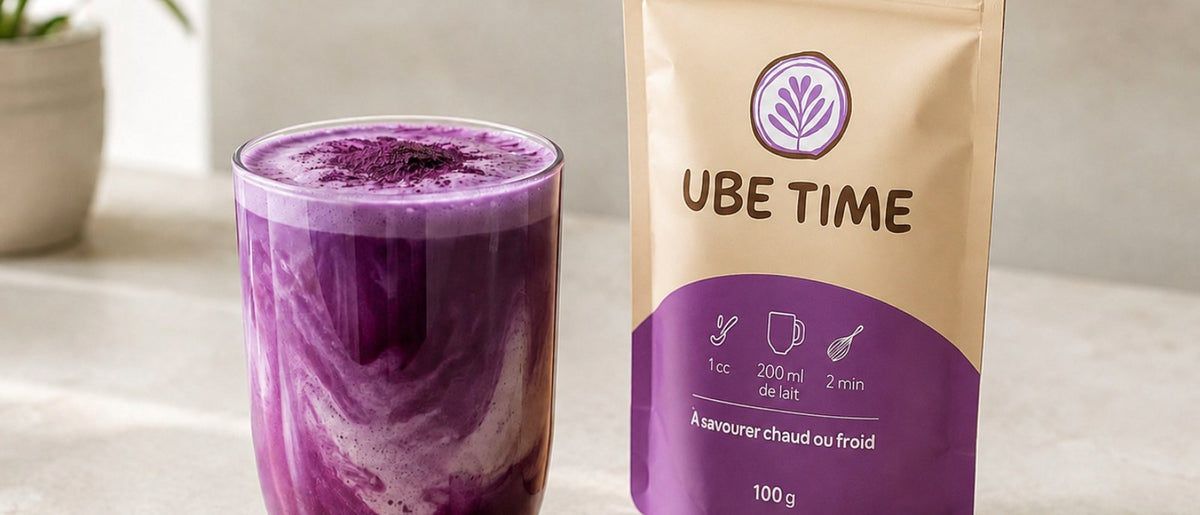
Take a 100 g pouch of 100% Kinampay ube powder. At around 5 g per cup, it makes about twenty ube lattes. The cost of the ube per cup then comes to a few tens of cents, compared with the €5 to €6 of a latte at the counter. The large format brings this cost down further, and the capsules add simplicity for barely more.
For the price of a single coffee shop latte, you make almost a whole week of homemade ube lattes. That's where pure powder makes all its sense.
The best ube latte, at the best price.
With our 100% Kinampay ube powder, each cup costs a few cents more than plain milk, for a coffee-shop treat at home.
Your questions: the price per cup.
How do I work out the price per cup of an ube latte?
Divide the product price by the number of lattes it makes. At around 5 g of powder per latte, a 100 g pouch makes about twenty drinks.
Is pure powder more economical than a preparation?
Per cup, often yes. A preparation contains little ube and a lot of sugar, so you use more. A concentrated powder is dosed finely and lasts longer.
Should I look at the price per kilo?
Yes, but with the ube percentage. A 100% ube powder that's a little dearer per kilo often works out cheaper per cup than a diluted blend.
Is a homemade ube latte cheaper than in a coffee shop?
Clearly. Made at home with powder, it costs a fraction of a latte at the counter.
Do capsules cost more per cup?
A little, in exchange for time saved and simplicity. Powder remains the most economical option, especially in a large format.