Ube latte problems, solved
Lumps, sediment at the bottom, too pale a colour, foam that collapses: most ube latte mishaps have a simple cause and a quick fix. Here is our troubleshooting guide.
Almost always a matter of method
A failed ube latte is not inevitable. In the vast majority of cases, the problem comes from a preparation detail: powder that didn't dissolve, milk that's too cold, or a dose to adjust. Let's go through the most common mishaps, one by one.
The secret to a smooth ube latte is one step: first make a paste with the powder and a splash of warm milk, before adding the rest of the milk.
Lumps and sediment at the bottom
This is mishap number one. Powder added straight into cold milk dissolves badly and forms lumps, or settles at the bottom of the glass.
The fix: first mix the powder into two or three spoons of slightly warm milk, until you get a smooth paste, then top up with the rest of the milk. A small whisk or an electric frother finishes the job.
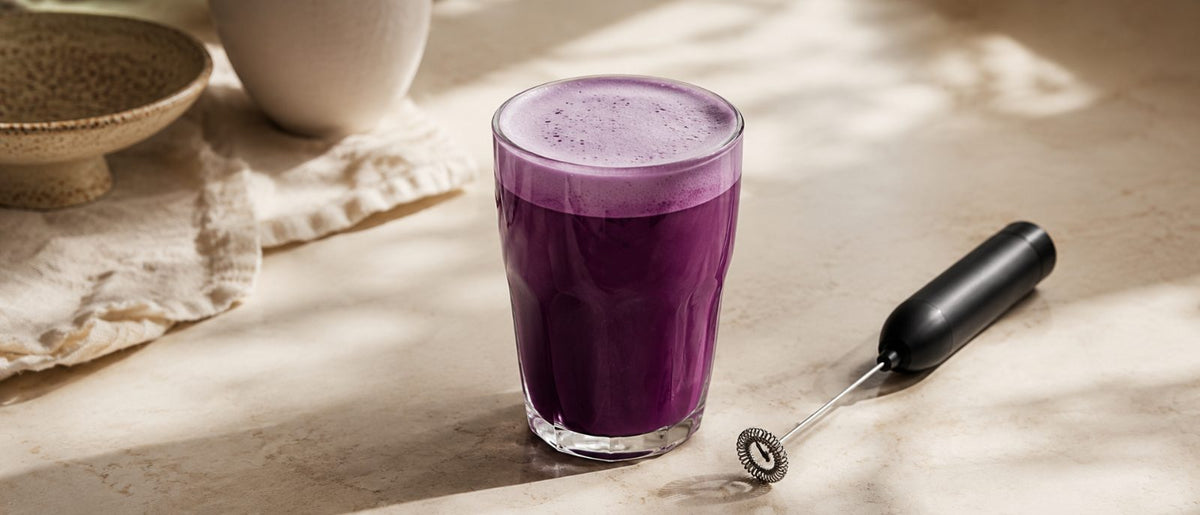
A handheld frother changes everything: it dissolves the powder and creates the foam at the same time, without lumps.
Colour too pale or too dull
If the purple lacks vibrancy, two possible causes: not enough powder, or a milk that's too white and opaque and masks the shade.
The fix: slightly increase the powder dose, and prefer a lighter milk like oat, which lets the purple stand out better. Avoid boiling the milk too much, excessive heat dulls the colour.
Texture too runny, taste too weak
A bland or too-light latte often signals under-dosing, or milk that's too diluted with water.
The fix: go up to two well-filled teaspoons for a large glass, use whole or barista milk for body, and taste before serving to adjust.
Pure powder isn't sweetened: if your latte seems «flat», maybe it just needs a touch of sweetener, not more powder.
Unstable foam or separation
Foam that collapses quickly, or a mix that separates, often comes from the chosen milk or the temperature.
The fix: a barista oat milk holds foam far better than a regular plant milk. Serve right away, and for an iced version, add the ice cubes at the last moment.
- Lumps: make a powder + warm milk paste before topping up.
- Pale colour: more powder, lighter milk, no over-boiling.
- Weak taste: raise the dose, add a sweetener if needed.
- Fragile foam: barista oat milk, serve immediately.
See the ube latte recipe, which milk to choose, or how to dose for colour.
A latte that works, every time.
With the right method and our 100% Kinampay ube powder, your ube latte is smooth, colourful and flavourful, no fuss.
Your questions: troubleshooting the ube latte.
Why does my ube powder go lumpy?
Because it was added straight into cold milk. First mix the powder into a little warm milk to get a smooth paste, then top up with the rest of the milk.
Why is my ube latte too pale?
Often from a lack of powder or a very white milk. Increase the dose a little and choose a lighter milk like oat, without overheating the milk.
Why does the powder settle at the bottom?
The sediment comes from incomplete dissolving. An electric frother or a small whisk, after making a paste, avoids this problem.
My latte tastes too weak, what should I do?
Go up to two well-filled teaspoons for a large glass, use whole or barista milk, and add a touch of sweetener if you like.
How do I get foam that holds?
Use a barista oat milk, froth it well and serve right away. For an iced version, add the ice cubes just before drinking.