Turning ube into powder
How do you go from the fresh tuber to violet powder? From drying to grinding, every stage matters to preserve the taste and colour of ube. Here is the making, behind the scenes.
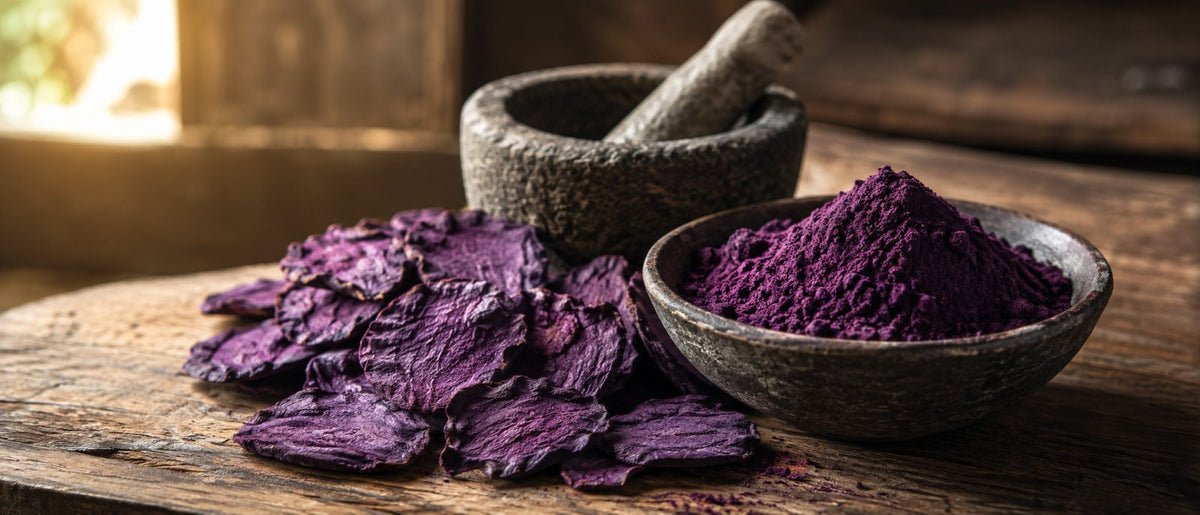
Drying to concentrate
The principle is simple: remove the water from the tuber to obtain a stable, concentrated material that is easy to keep. But everything is in the execution. Well-managed drying preserves the violet colour and the vanilla-and-nutty taste; drying that is too aggressive dulls them. It is a craft.
It takes several kilos of fresh ube to obtain one kilo of powder. This concentration is why a small dose is enough to colour and flavour.
From tuber to powder: the stages.
| Stage | Role |
|---|---|
| Selection | Choose ripe, well-coloured tubers |
| Cleaning | Wash and peel the tubers |
| Cutting | Slice thinly for even drying |
| Drying | Gently remove the water, preserve colour and taste |
| Grinding | Reduce to a fine powder |
| Sifting | Obtain a smooth, free-flowing powder |
Role
Checks and packaging
Once the powder is obtained, come the checks: colour, fineness, smell, absence of moisture. The powder is then packaged away from air and light, in packaging that protects its freshness all the way to you. It is this final care that guarantees a smooth, colourful powder on opening.
A fine powder is recognised by its even violet colour and its fineness. These are the signs of well-mastered drying and grinding.
The effect of the process on taste and colour
The transformation does not distort ube: when well done, it concentrates its qualities. The powder keeps the tuber's authentic taste and a natural violet colour. It is the very opposite of a mix cut with sugar and colouring, where the process serves mainly to hide the lack of ube.
- The powder is dried then ground ube, nothing more.
- Drying removes the water and concentrates the product.
- A good process preserves colour and taste.
- Checks and packaging guarantee freshness.
See growing and harvesting, the forms of ube, or the Ube Time powder.
All this work, in one pouch.
Our 100% ube Kinampay powder is the fruit of a careful transformation, designed to preserve the best of the yam: its colour and its taste.
Your questions: the making.
How is ube powder made?
Ripe tubers are selected, cleaned, sliced, dried to remove the water, then ground and sifted to obtain a fine, even powder.
Does drying harm the colour of ube?
Drying that is too aggressive can dull the colour. Well managed, gently, it preserves the natural violet and the tuber's taste.
How much fresh ube for a kilo of powder?
Several kilos, because drying removes the water. This concentration is why a small dose of powder is enough.
Does the transformation add ingredients?
No, for a pure powder like ours: it is only dried, ground ube, with no sugar, flavouring or colouring.
How do you recognise a well-made powder?
By its even violet colour, its fineness and its flowability. These are the signs of well-mastered drying and grinding.