Ube powder vs colouring
Violet can come from two opposite worlds: from a root, or from a bottle. Understanding the difference is understanding why ube needs no additive to colour.
Colour: two philosophies
On a shelf, two violets can look identical. Yet one comes from a whole ingredient, the other from an additive designed to tint.
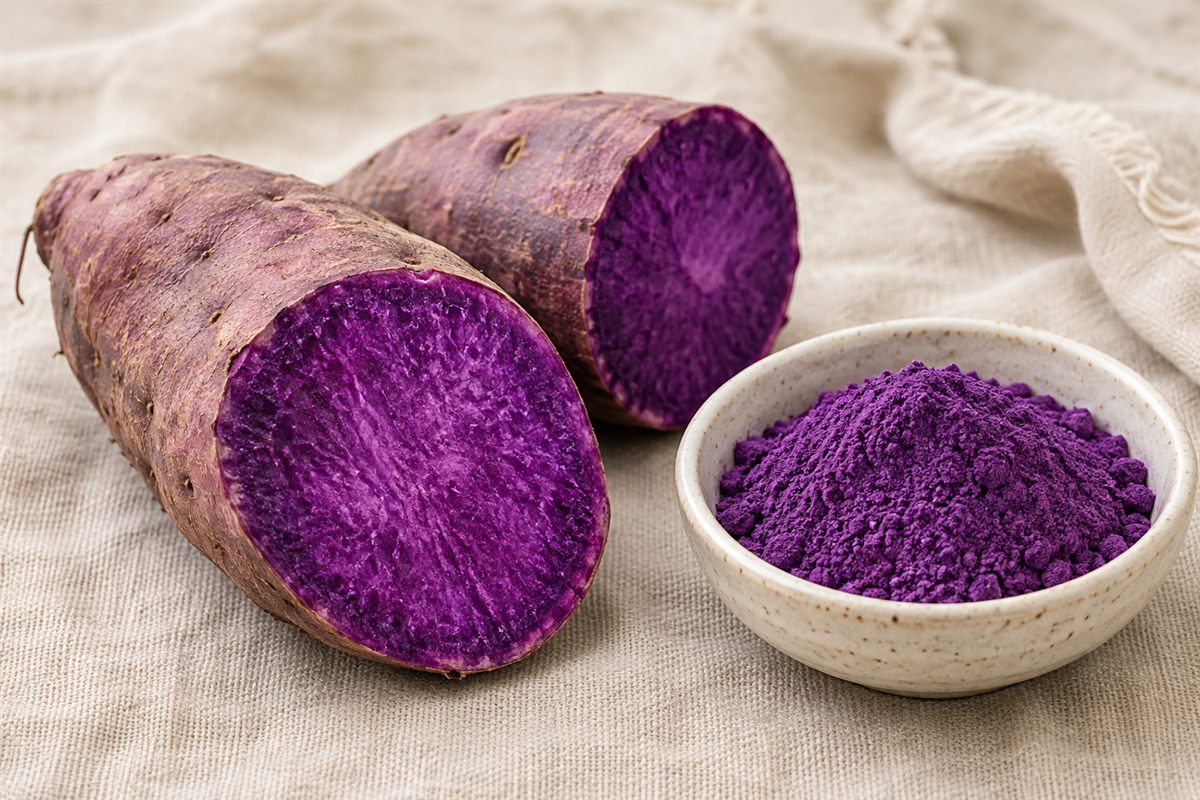
Ube powder is simply a dried and ground purple yam: the colour is already in the plant. A food colouring, on the other hand, is added to a preparation to give it a hue it does not have naturally.
Many "violet" desserts on the market contain no ube at all: their colour comes from a colouring, sometimes even from a red + blue mix.
Ube or colouring: the real from the fake.
| Criterion | Ube powder | Colouring |
|---|---|---|
| Origin | Whole purple yam | Additive (natural or synthetic) |
| Role | Ingredient: colour + taste | Tint only |
| Taste added | Mild, vanilla, hazelnut | None (or aftertaste) |
| Contribution | Fibre, matter of the yam | No nutritional contribution |
| Label | 100% ube | E number or 'colouring' |
Ube powder
Colouring
Ube: the colour comes from the plant
The violet of ube comes from anthocyanins, natural pigments present in the root, the same as in blueberry or red cabbage. When you colour a latte with ube, you are therefore adding a real food, not a dye.
The result: the colour comes with a mild, vanilla taste, and a bit of matter (the yam itself).
With ube, "colouring" and "ingredient" are one and the same. Nothing is added just for the hue: it is the whole plant.
Colourings: effective, but apart
A food colouring has a single role: to give a colour. There are natural ones (extracts of fruit, vegetables, algae) and synthetic ones. All are added in small quantity and bring neither a sought-after taste nor matter.
For a bright, uniform violet at lower cost, they are handy. But you then move away from the idea of a whole, natural ingredient.
So, ube or colouring?
If you just want a cheap violet hue, a colouring will do. But if you want a natural colour that also has taste, with no additive, it is ube: an ingredient, not a dye.
- Ube is a whole yam: the colour is in the plant.
- A colouring only tints: no taste, no contribution.
- Our powder is 100% ube, with no colouring or additive.
See why ube is violet, compare it with the other coloured powders, or go back to basics: what is ube?
The real natural violet.
Our powder is 100% ube Kinampay: a colour that comes from the plant, a mild taste, zero colouring.
Your questions: ube or colouring.
Is ube powder a colouring?
No. It is a whole purple yam, dried and ground. It colours naturally, but it is a full ingredient, not an additive.
Is the colour of ube really natural?
Yes. It comes from anthocyanins, pigments naturally present in the root. No colouring is added to our powder.
Why do some 'ube' products have such a bright colour?
Sometimes their violet is boosted or entirely obtained with an added colouring. Check the ingredient list: a real ube powder is simply '100% ube'.
Can you replace a violet colouring with ube powder?
Yes, in baking and in drinks. The hue will be a little milder and more natural, and you get ube's vanilla taste as a bonus.
Does ube powder contain additives?
Ours does not: it is 100% ube Kinampay, with no colouring, no preservative and no added sugar.