The forms of ube
Fresh, powdered or extract: ube comes in several forms, and they're not all equal. Here is how to tell them apart to choose well according to your wishes.
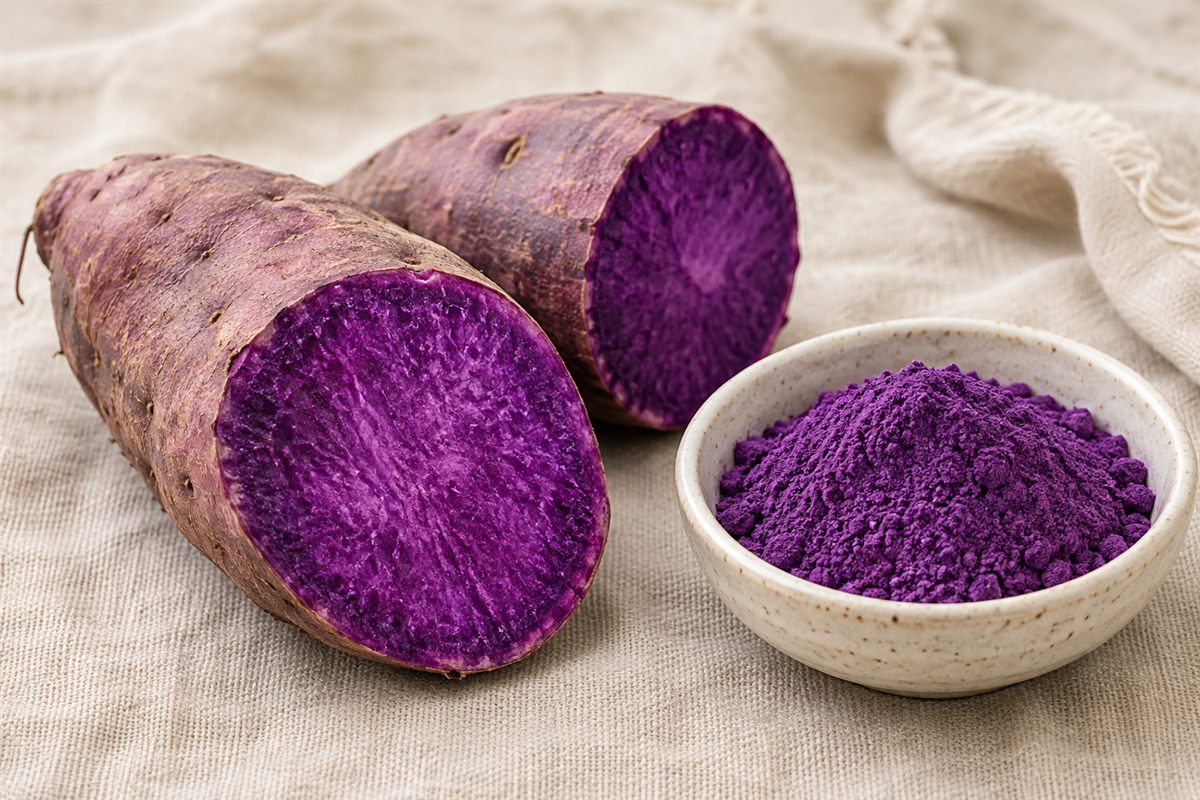
In what form do you find ube?
Outside the Philippines, fresh ube is rare. Fortunately, it comes in several more accessible forms: powder, extract (or flavouring), and sometimes the fresh tuber in Asian grocery stores.
Each form has its uses… and its degree of authenticity.
Many "ube extracts" on the market are mostly coloured flavourings: their purple comes from a colouring, not from the yam.
Fresh, powder or extract: the comparison.
| Criterion | Fresh ube | Ube powder | Extract |
|---|---|---|---|
| Appearance | Whole tuber | Fine powder | Liquid / flavouring |
| Availability | Rare outside Asia | Easy, online | Variable |
| Storage | Short | Long (months) | Long |
| Colour | Natural | Natural, intense | Often coloured |
| Preparation | To cook / reduce | Ready to use | A few drops |
| Taste | Authentic | Authentic, concentrated | Flavoured |
Fresh ube
Ube powder
Extract
Fresh ube
This is ube in its rawest form: the whole tuber, with purple flesh. Authentic, but impractical outside the Philippines: hard to find, it has to be peeled, cooked then mashed before use.
Reserved for purists ready to cook from scratch.
Ube powder
This is the most versatile and reliable form. Powder is simply dried and ground ube: it keeps the colour and taste of the root, lasts for months, and is used directly — a spoonful is enough to colour and flavour a preparation.
Ideal for lattes, pastry, ice creams and everyday use.
For most uses, powder is the best compromise: the authenticity of fresh ube, plus simplicity. It's the form we chose.
Extract (or flavouring)
Ube extract is a liquid concentrate, often used to flavour and colour quickly. Handy, but be careful: many extracts are mostly coloured flavourings, whose purple comes from a colouring rather than from the yam.
To keep for cases where you mainly want a splash of colour and a touch of aroma.
An extract isn't always "ube". Read the label: a real powder is "100% ube", with no additive.
So, which form to choose?
For authentic, simple and lasting use, powder wins: it offers the real colour and taste of ube, without the constraint of fresh or the additives of extract.
- Fresh: authentic but rare and long to prepare.
- Powder: the best compromise — real taste, long storage, ready to use.
- Extract: handy, but often flavoured and coloured.
See how to use the powder, how to choose it well, or go back to what is ube?
The simplest form.
Our Kinampay ube powder: the real taste and real colour of ube, ready to use. No additive.
Your questions: the forms of ube.
What is the best form of ube?
For most uses, powder: it keeps the taste and colour of fresh ube, lasts a long time and is used directly.
Where can I find fresh ube?
Mainly in Asian grocery stores, and even then, rarely. Outside the Philippines, powder is far more accessible.
Is ube extract natural?
Not always. Many extracts are coloured flavourings whose purple comes from a colouring. Always check the ingredient list.
Does ube powder taste the same as fresh ube?
Yes, in concentrated form. Drying preserves the colour and aroma of the root; you just rehydrate the powder in your preparations.
How long does ube powder keep?
Several months, away from light and moisture, unlike the fresh tuber, which is perishable.