Why Choose Kinampay?
Not all purple yams are equal. Kinampay is considered the noblest of them all, the one Filipinos save for their finest desserts.
Its variety, its birthplace, its aroma, its rarity: here's everything you need to know about the ube we chose, so it holds no more secrets for you.
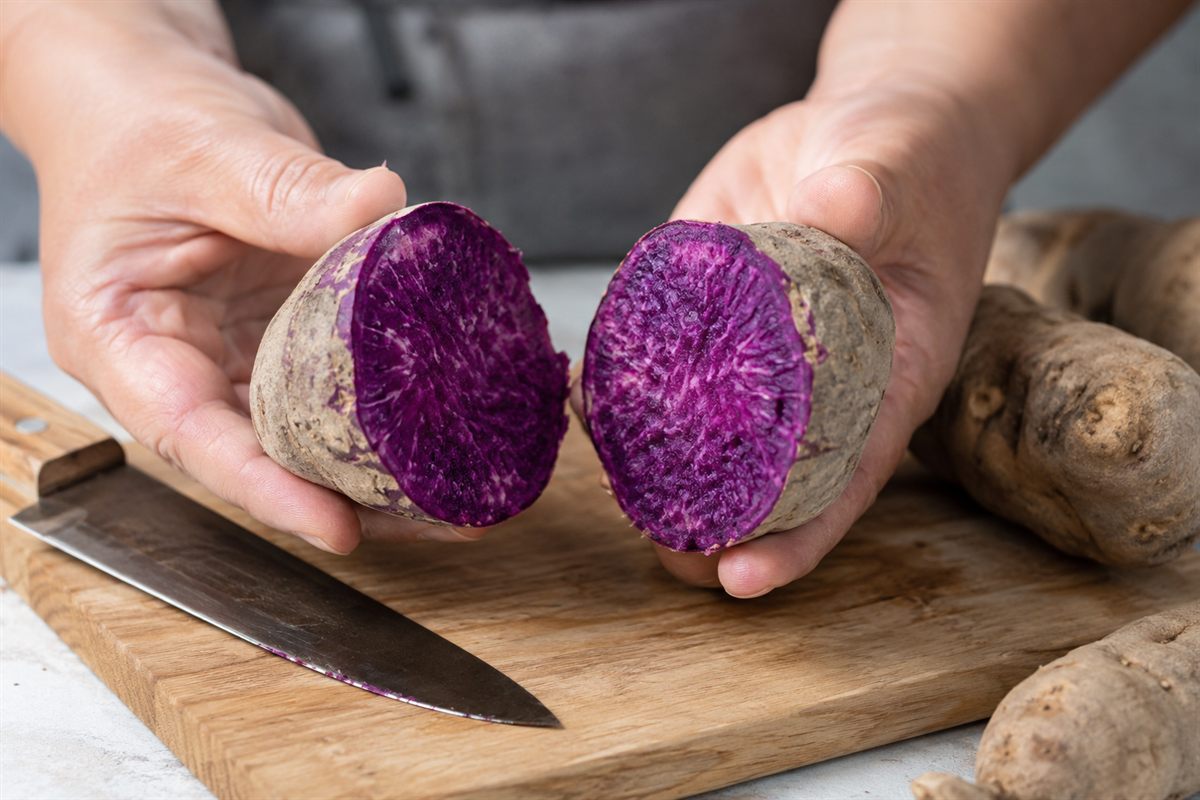
The king variety of ube
There are dozens of purple yams. Only one is unanimous among Filipino pastry chefs: Kinampay.
It's the variety saved for special occasions, the one spoken of with pride, the one you choose for the dessert that has to impress. Its very name, over there, evokes a promise of quality.
Its reputation owes nothing to chance. It comes from a rare combination: a colour, an aroma, a fineness and a history that other varieties can't match.
"Ube" refers to the purple yam in general. "Kinampay" refers to a specific variety, the most prized of them all. Saying Kinampay is a bit like saying "grand cru" rather than simply "wine".
Ube, purple yam, Kinampay: untangling the words
Three words that are often confused. Let's clear it up once and for all.
Ube is a purple-fleshed yam, a tuber grown for centuries in Southeast Asia. Nothing to do with the purple sweet potato, with which it's frequently confused.
Kinampay isn't another vegetable: it's a variety of ube, the most sought-after. Just as there are several varieties of apple, there are several purple yams, and Kinampay is the pinnacle.
Find out what ube exactly is, and the difference with the purple sweet potato.
 Bohol, birthplace of Kinampay
Bohol, its birthplace
Every great product has a land. For Kinampay, it's the island of Bohol, in the Philippines.
There, growing it is a tradition passed down from generation to generation. It's harvested, cooked and celebrated. Kinampay is part of the island's culinary heritage, to the point of being a genuine local pride.
Here, ube isn't just an ingredient: it belongs to childhood memories, family celebrations and the desserts you never forget.
What makes it so rare
Kinampay has to be earned.
More delicate to grow than ordinary yams, it takes time and the right soil and climate. It isn't mass-produced: it follows the rhythm of the land, not that of industry.
This rarity explains its price. A real Kinampay costs more than a generic yam, simply because it's rarer and more sought-after. That's the price of the exceptional.
Be wary of a "premium" ube sold at a knockdown price. Quality has a cost, and real Kinampay isn't given away.
A unique sensory profile
Close your eyes and imagine.
First the colour: a deep, almost unreal purple that turns to a luminous mauve once mixed with milk. This purple is entirely natural, thanks to anthocyanins, the same pigments as in blueberry or red cabbage.
Then the aroma: a vanilla sweetness, a hint of hazelnut, something round and comforting, worlds away from the earthy taste of an ordinary yam.
Finally the texture: remarkably fine, Kinampay blends without lumps and leaves a silky feel in the mouth.
It's the anthocyanins that give Kinampay its colour. The richer the variety is in them, the deeper the purple, without the slightest dye.
Kinampay or generic ube: the real difference
On the label, everything looks alike. In the cup, everything changes.
A generic yam gives a pale purple, a neutral, sometimes earthy taste, a floury texture. To make up for it, some products add dye and flavouring: the colour turns neon, the taste artificial.
Kinampay needs no such tricks. Its colour and aroma are natural, because they come from the variety itself, not from an additive.
- A purple that's too vivid, almost neon.
- A long list of ingredients.
- A surprisingly low price.
Three signs that it isn't a real Kinampay.
How to recognise a real Kinampay
Four reflexes are enough.
The variety: it should be clearly stated. A good product proudly announces its Kinampay. The colour: a clear, deep purple, never neon. The composition: a single ingredient, ube, with no dye or flavouring. The origin: the Philippines, its reference home.
At the slightest doubt, read the ingredient list. It never lies: a real Kinampay has only one.
Why Ube Time chose Kinampay
At Ube Time, the question never arose.
We wanted to offer the true taste of ube, not a coloured imitation. That called for a single choice: the best variety, no compromise. Kinampay, the top of the basket, the very best.
The result: our powder contains a single ingredient, Kinampay ube. No dye, no flavouring, no additives. Its deep colour and vanilla aroma are entirely natural, exactly as in Bohol.
Choosing Kinampay means refusing compromise. It's the guarantee that what you taste is truly ube, and the very best of it.
The same Kinampay, as powder and as capsule
Quality shouldn't depend on how much time you have.
That's why we offer our Kinampay in two forms. The powder, for those who like to measure, whisk and build their latte like a barista. And the capsule, our innovation: the first ube latte in a capsule, pre-dosed, ready in thirty seconds.
In both cases, it's the same premium Kinampay. Never anything else.
Ube latte capsules existed nowhere before us. We were the first to imagine them, to make ube as simple as a morning coffee.
How to enjoy it every day
Kinampay isn't just for special days.
As an ube latte, hot or iced, it's its simplest and most iconic form of expression. In baking, it colours and flavours cheesecakes, cookies and pancakes. As a frozen dessert, it recalls the famous ube ice cream of the Philippines.
Follow the ube latte recipe, or learn how to choose a good ube powder.
Want the real Kinampay?
As a powder to prepare, or a capsule ready in 30 seconds. Always the same exceptional variety.
Your questions about Kinampay.
What is Kinampay?
It's the most prized ube variety, tied to the island of Bohol in the Philippines, renowned for its vanilla aroma and deep colour.
What's the difference between ube and Kinampay?
Ube refers to the purple yam in general. Kinampay is a specific variety of ube, the most sought-after. All Kinampay is ube, but not all ube is Kinampay.
Why is Kinampay more expensive?
Because it's rarer and more delicate to grow. That price reflects a higher quality: a selected variety, naturally coloured, with no additives.
Where does Kinampay come from?
From the Philippines, and more specifically the island of Bohol, where growing it is a tradition.
Are all ube powders Kinampay?
No. Many use generic yams, sometimes boosted with dye. That's why it's best to check the stated variety.
Is Ube Time's powder Kinampay?
Yes. Our powder contains a single ingredient: Kinampay ube, with no added dye or flavouring.
Do Ube Time capsules also use Kinampay?
Yes. Our ube latte capsules contain the same premium Kinampay as our powder, simply pre-dosed for a latte ready in 30 seconds.
Does Kinampay contain dye?
No. Its purple colour is entirely natural, due to anthocyanins. That's precisely what sets a real Kinampay apart from a dyed yam.