Fresh ube, powder, paste and purée
Ube comes in several forms, and each has its uses. Fresh, powder, paste or purée: here is how to tell them apart and which to choose depending on what you're cooking.
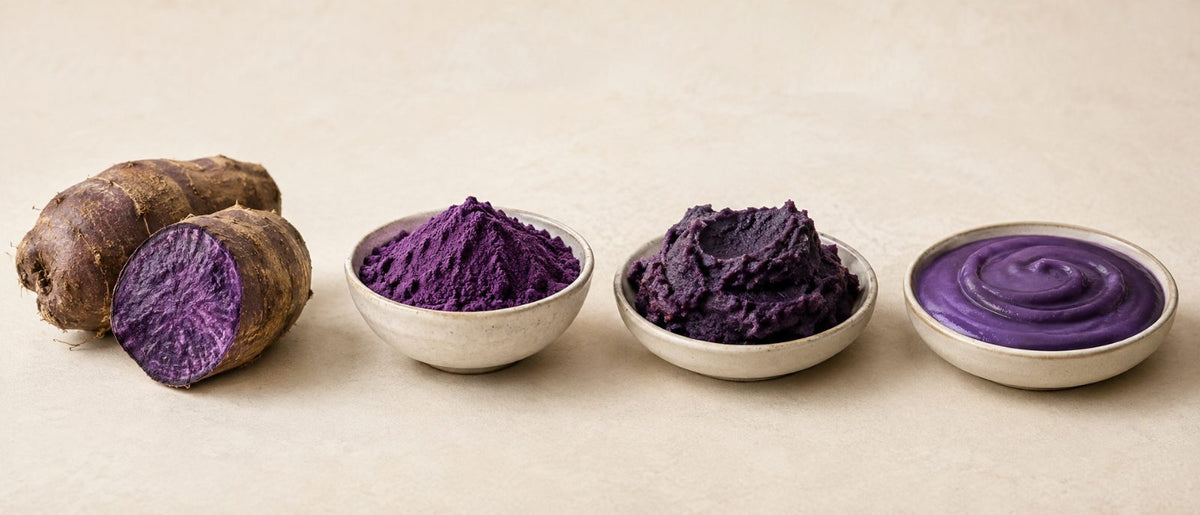
One root, several forms
Originally, ube is a fresh tuber, a yam with violet flesh. But fresh, it is hard to find and to keep outside Asia. That is why it also exists as powder, as paste (often sweetened, like halaya) and as purée. Each answers a different need.
Powder is the most stable and practical form: it keeps for months, is measured to the gram and works as well for a drink as for a cake.
The four forms: the comparison.
| Criterion | Fresh | Powder | Paste | Purée |
|---|---|---|---|---|
| Added sugar | None | None | Often yes | Variable |
| Shelf life | Short | Long (months) | Medium | Short |
| Preparation | Cooking required | Ready to use | Ready to use | Ready to use |
| Dosing | Approximate | Precise | Approximate | Approximate |
| Versatility | Good | Excellent | Desserts mostly | Desserts mostly |
| Availability (Europe) | Rare | Easy | Medium | Medium |
Fresh
Powder
Paste
Purée
Each form in detail
Fresh: the raw tuber, to peel and cook. The most authentic, but rare outside Asia and fragile to keep.
Powder: dried and ground ube. The most practical and versatile form: precise dosing, long shelf life, as good for drinks as for baking.
Paste: a cooked preparation, often sweetened (like halaya). Ready to spread or fold into a dessert, but less neutral.
Purée: fresh ube, cooked and mashed. Ideal in baking, but to keep cold and use quickly.
For everyday use, drinks and desserts alike, powder is the best compromise: one single form, a thousand recipes, and you control the sugar.
Which to choose?
To cook ube every day with no constraint, powder stands out: practical, precise, long shelf life and zero added sugar. Fresh and purée are perfect if you find them and cook straight away. Paste, for its part, is more of a finished product, indulgent and sweet.
- Powder: the most versatile and the simplest to dose and keep.
- Fresh / purée: authentic but fragile and little available.
- Paste: indulgent, often sweetened, for desserts.
See all the forms of ube, pure powder or ready mix, or how to use the powder.
Powder, the freest form.
Our 100% ube Kinampay powder keeps for a long time and lends itself to all your recipes, from latte to cake.
Your questions: which form of ube?
What is the best form of ube?
For versatility and simplicity, powder: it doses precisely, keeps for months and works as well for drinks as for baking. Fresh and purée are more authentic but rare and fragile.
What is the difference between ube paste and purée?
Paste (like halaya) is a cooked, often sweetened preparation, ready to eat. Purée is simply fresh ube, cooked and mashed, with no added sugar, to use quickly.
Can you replace fresh ube with powder?
Yes. Rehydrated powder replaces fresh ube very well in most recipes, with the advantage of precise dosing and long shelf life.
Where to find fresh ube in Europe?
Fresh ube is rare outside Asia and keeps poorly. Powder is far easier to find and to use every day.
Which form for an ube latte?
Powder, without hesitation: it dissolves in milk, doses easily and gives a beautiful natural violet colour.