Origin of Ube
To understand ube, you first have to travel. Head for the Philippines, an archipelago of over seven thousand sun-drenched islands, where this purple yam has been loved for generations.
Its story is that of a root that became a treasure.
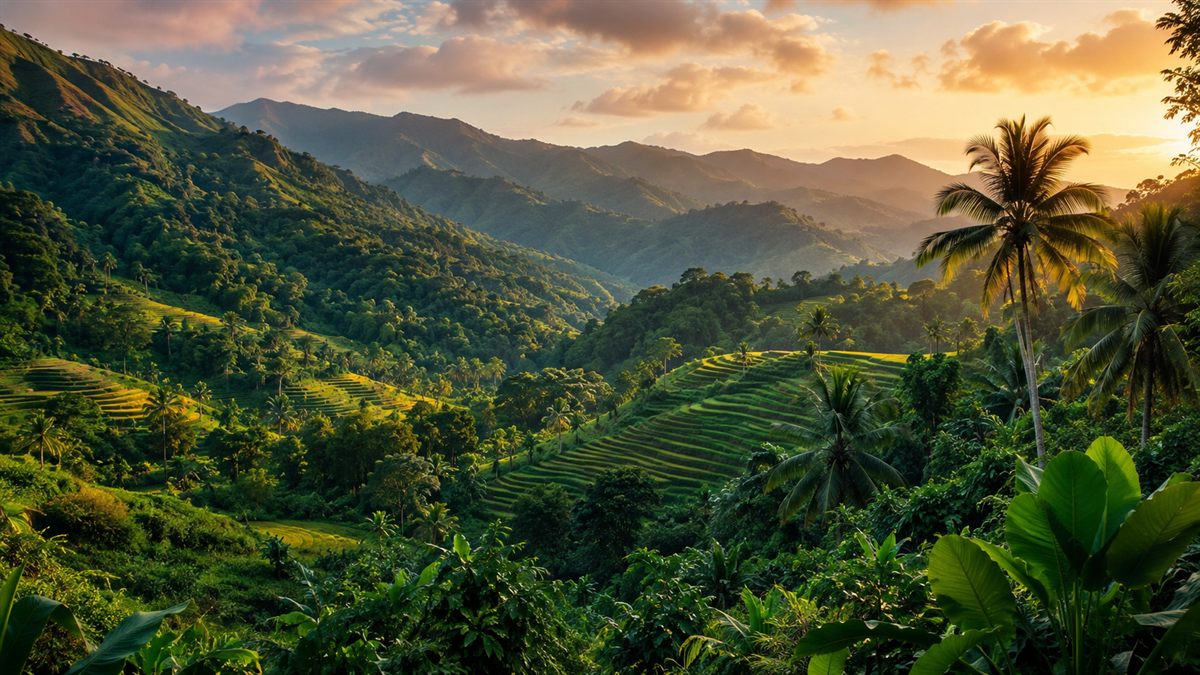
A yam born in the tropics
Ube grows in the humid heat of the Philippines, on fertile land bathed in rain and sun.
Botanically, it's the tuber of a climbing vine (Dioscorea alata). The plant coils towards the light while, underground, the root slowly swells over several months before harvest.
That long wait is the secret of its richness: ube is in no hurry. It takes the time to develop its colour and aroma, at the pace of the tropical soil.
This warm, humid climate is irreplaceable. It's what gives ube its dense flesh and deep colour, hard to reproduce elsewhere.
 The Philippines, the homeland of ube
One archipelago, a thousand terroirs
Over seven thousand islands, one shared love for ube.
From the rice paddies of Luzon to the hills of the Visayas, ube is grown almost everywhere in the archipelago. Each region has its habits, its varieties, its recipes.
But one island stands out for the quality of its ube: Bohol, home of the most prized variety, Kinampay.
An ancestral tuber
Long before cafés and social media, ube was already there.
Like most yams, it's among the oldest food plants in Southeast Asia and the Pacific, grown for centuries as a staple. Nourishing, easy to store, it has crossed the generations.
Over time, it went from an everyday food to a festive ingredient, celebrated for its colour and sweetness.
"Ube" (or "ubi") simply means "yam" in Filipino. A very simple name for an ingredient that has become a cult favourite around the world.
 Kinampay, the king variety
Kinampay, the ube of special days.
Not all purple yams are equal.
The most sought-after is tied to the island of Bohol: Kinampay. A more delicate aroma, a deeper colour, a fineness that makes it the benchmark.
There, it's saved for special occasions. It's the ube of the days that matter, and the one we chose for Ube Time.
The ingredient for special days
In the Philippines, ube is passed down from generation to generation, like a family secret.
It's cooked in a thousand ways: ube halaya, a creamy, glossy jam; halo-halo, that colourful iced dessert; hopia, a small filled pastry; ensaymada, a soft brioche. Not to mention ice creams and birthday cakes.
At celebrations, at Christmas, at big family tables, its purple colour is a celebration in itself. Every bite awakens a childhood memory.
Ube ice cream and halo-halo are among the most loved desserts of the archipelago. It's impossible to imagine a celebration without a touch of purple.
 One spoonful, a whole journey
From root to powder.
How a yam becomes the ingredient in your cup.
Once harvested, ube is cleaned, cooked, then dried before being ground into a fine, fragrant powder.
In this form, it keeps for a long time, retains all its colour and is measured by the spoon. It's the simplest way to find, here, the taste of the Philippines, where the fresh tuber travels poorly and keeps for only a short time.
From the Philippines to the rest of the world
For a long time, ube remained a well-kept secret of Southeast Asia.
Then, in the mid-2010s, its spectacular colour won over cafés, bakeries and social feeds around the world. First in the United States, carried by the Filipino diaspora, then almost everywhere. Today, you enjoy an ube latte in Manila as in Paris.
What was once a local festive ingredient became a global phenomenon, without ever losing its soul.
Ube today, between tradition and trend
Now trendy, ube has also attracted imitations: coloured powders, artificial flavourings, generic varieties.
At Ube Time, we made the opposite choice: to stay true to the origin. An authentic ube, of the Kinampay variety, with no dye or additive, offered as a powder to prepare and as a capsule ready in thirty seconds.
The tradition of the Philippines, in your cup, with no compromise whatsoever.
To go further: what ube really is, why choose Kinampay, or the secret of its purple colour.
Fancy a taste?
The origin in your cup is even better. To make with our powder, or ready in 30 seconds with our capsules.
Your questions about the origin.
Where does ube come from?
Ube originates from the Philippines, where it has been grown for centuries and is part of the local food culture.
How long has ube been grown?
For centuries: like most yams, it's among the oldest food plants of Southeast Asia and the Pacific.
Does ube grow in France?
No, ube needs a tropical, warm and humid climate. It's imported, most often as a powder.
What is Kinampay?
It's the most prized ube variety, tied to the island of Bohol, renowned for its aroma and colour.
How does ube reach us?
Once harvested, it's cooked, dried then ground into a fine powder, which keeps for a long time and retains its colour.
Why is ube mostly sold as a powder?
Because the fresh tuber travels poorly and keeps for only a short time. The powder keeps its colour and aroma all year, and is easy to measure.
How long has ube been known around the world?
It's been traditional in the Philippines for centuries; its global popularity soared in the mid-2010s, driven by its colour.
In which dishes is ube found in the Philippines?
Mostly in desserts: ube halaya (jam), halo-halo (iced dessert), ice creams, brioches and celebration cakes.