Ube or Taro
They are endlessly confused, because of their link to purple. And yet ube and taro are two quite different plants, each with its own character.
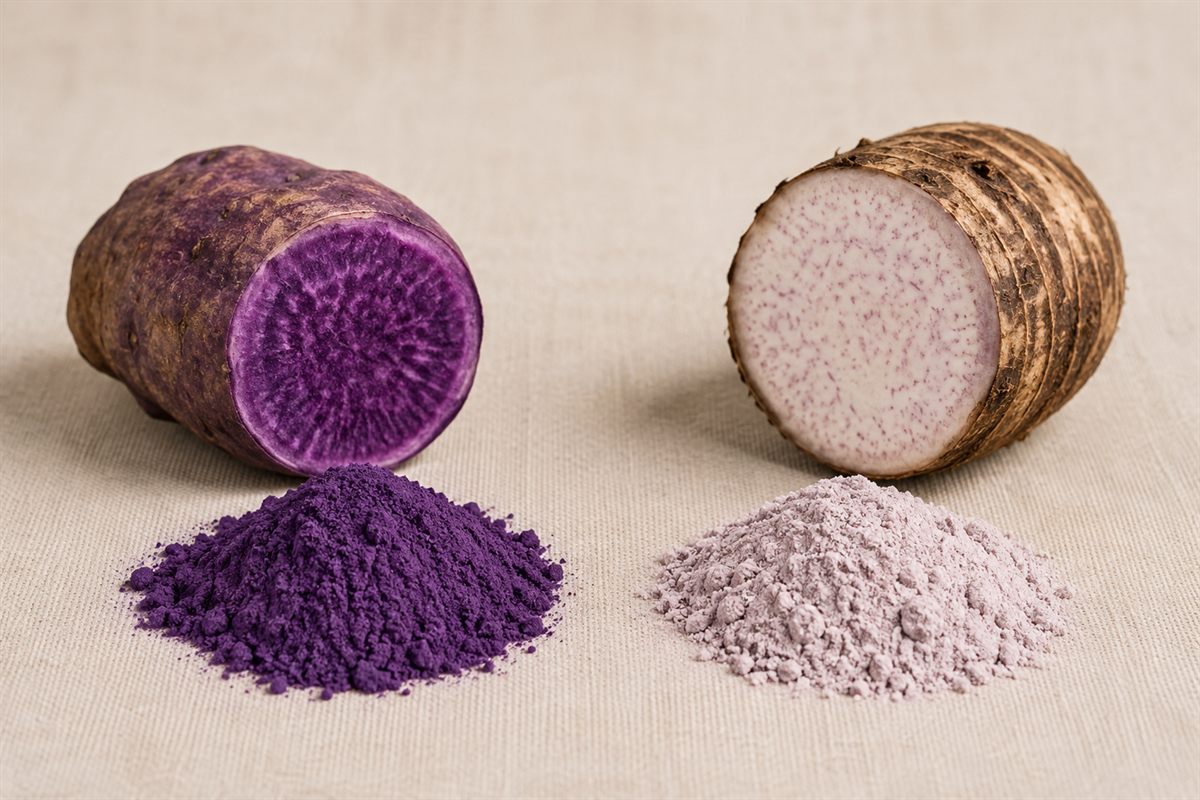
Two roots, two families
This is the classic mix-up of the Asian aisle. You think you see the same purple, you imagine the same taste.
In reality, ube and taro do not even belong to the same plant family. Once you know it, you never confuse them again.
Ube or taro: the match-up.
| Criterion | Ube | Taro |
|---|---|---|
| Nature | Purple yam (root) | Taro (corm, aroid plant) |
| Botanical name | Dioscorea alata | Colocasia esculenta |
| Colour | Natural purple (anthocyanins) | White to pale mauve |
| Taste | Sweet, vanilla, sugary | Neutral, earthy, barely sweet |
| Use | Mostly sweet | Sweet and savoury |
| Caffeine | None | None |
Ube
Taro
A yam versus a taro
Ube (Dioscorea alata) is a yam: the tuber of a climbing vine, emblematic of the Philippines.
Taro (Colocasia esculenta) belongs to a wholly different family, the aroids. It is not a root but a corm, a swollen underground stem, cultivated in Asia for a very long time.
Taro is among the oldest cultivated plants in the world. It is almost always eaten cooked: cooking is what makes it tender and digestible.
The purple: natural in one, added in the other
This is where it all plays out. Ube is naturally purple, thanks to anthocyanins.
Taro, for its part, has flesh that is most often white or very pale mauve. The pretty purple of taro bubble teas therefore comes, most of the time, from added colouring.
With ube, the colour is in the ingredient. No additive needed: it is the plant that colours.
Taste: dessert versus dish
Ube is sweet, vanilla, lightly sugary. It heads straight for desserts and indulgent drinks.
Taro is more neutral and earthy, close to chestnut or potato. It lends itself to sweet as much as savoury.
For a mild, colourful latte, without bitterness or earthy taste, ube is the obvious choice. Taro, meanwhile, shines in more rustic recipes.
The famous taro of bubble tea
If you know taro, it is probably thanks to bubble tea.
That taro, a very even pastel purple, is often made from flavoured, coloured powder. Delicious, but quite far from raw taro, which is rather neutral and pale.
Ube, for its part, needs no such helping hand: its purple and its sweetness are already there, in the root.
Many « taro » drinks draw their colour and sweet taste from a preparation, not from the corm itself.
Two ways to cook
Ube slips into lattes, ice creams, cakes and creams. Taro, more at ease on the savoury side, also turns up mashed, as fries or in simmered dishes.
- Ube is a yam (Dioscorea alata), taro an aroid (Colocasia esculenta).
- Ube is naturally purple; taro is pale, its colour is often added.
- Ube: sweet and sugary. Taro: neutral and earthy.
So, ube or taro?
It all depends on what you are after.
For a latte or a mild, colourful, natural dessert, ube wins hands down: real purple, vanilla taste, zero additives. Taro, for its part, comes into its own in cooking, from sweet to savoury, when you love its neutral, rustic side.
Compare ube with matcha and purple sweet potato, or go back to basics: what is ube?
Team purple?
Discover ube, the real natural purple, mild and caffeine-free. In powder, or in a capsule ready in 30 seconds.
Your questions: ube or taro.
Are ube and taro the same?
No. They are two plants from different families: ube is a yam, taro an aroid.
Is taro purple like ube?
No, its flesh is often white or pale mauve. The purple of taro products is generally added.
What does taro taste like compared to ube?
Taro is neutral and earthy, close to chestnut; ube is sweet, vanilla and more sugary.
Is taro bubble tea natural?
Often not: its even purple colour and sweet taste frequently come from a flavoured, coloured powder.
Ube or taro for a latte?
Ube: naturally purple, mild and additive-free. Taro most often needs a coloured preparation.
Can you replace taro with ube?
In sweet recipes, yes, but the colour and taste will differ: more purple and milder.
Does taro contain caffeine?
No, like ube, taro is naturally caffeine-free.
Why are ube and taro so often confused?
Because of the purple, associated with both in Asian desserts, whereas in taro it is most often added.