Ube or Matcha
One is purple, the other green. Both light up café menus the world over. But beyond the colour, ube and matcha have almost nothing in common.
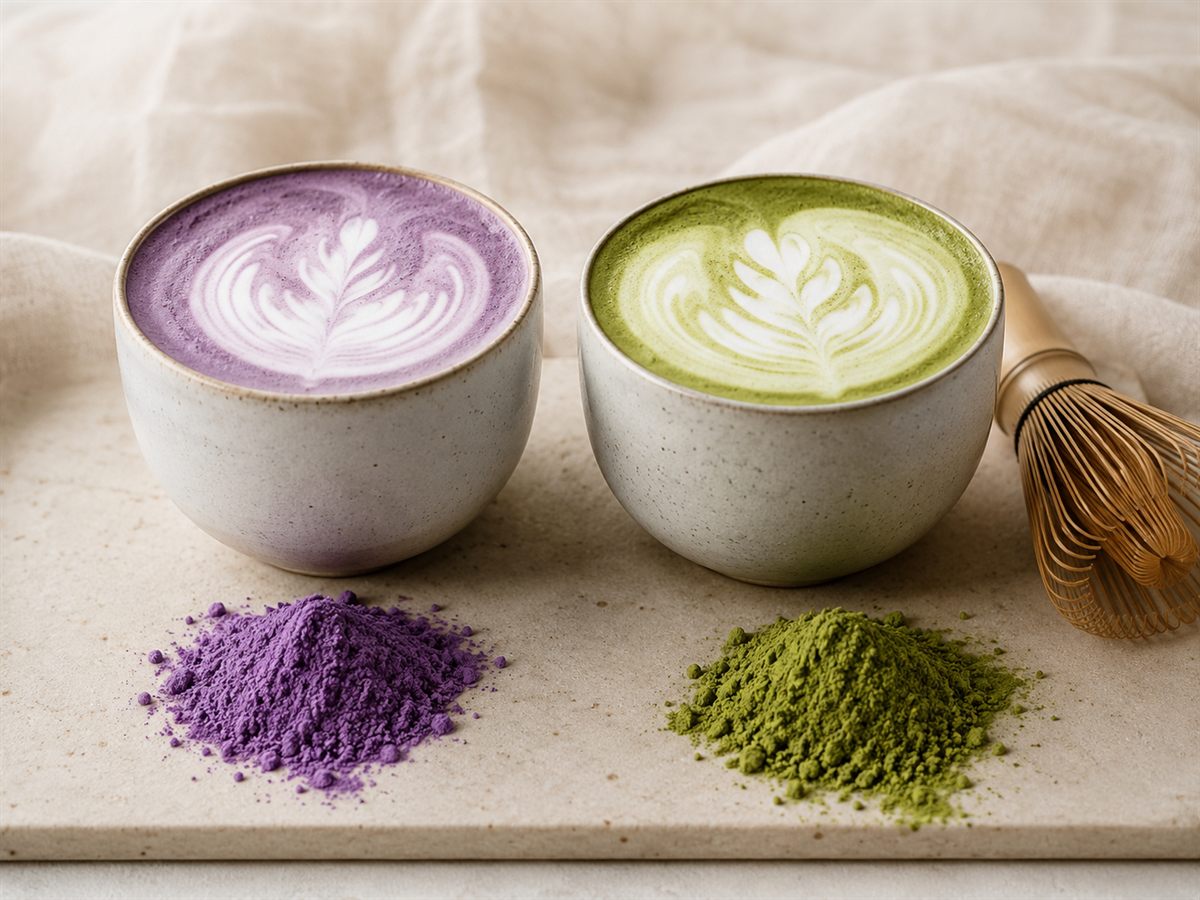
Two colours, two worlds
You meet them side by side, in a latte or in pastry. The deep purple of ube, the bright green of matcha. Two icons of cafés the world over.
And yet everything sets them apart. One is a root, the other a leaf. One is sweet, the other bold. One keeps you company in the evening, the other wakes you in the morning.
Here is how to never mix them up again.
Ube or matcha: the match-up.
| Criterion | Ube | Matcha |
|---|---|---|
| Nature | Purple yam (root) | Ground green tea (leaf) |
| Origin | Philippines | Japan |
| Colour | Purple (anthocyanins) | Green (chlorophyll) |
| Taste | Sweet, vanilla, nutty | Vegetal, umami, bitter |
| Caffeine | None | Yes (stimulating) |
| Best for | Any time, even the evening | Mornings, a wake-up kick |
Ube
Matcha
A root versus a leaf
Ube (Dioscorea alata) is a purple yam: a tuber that grows underground, in the Philippines. It is harvested, dried, then ground into a fine powder.
Matcha comes from Japan. It is green tea leaves, grown in the shade to concentrate their colour, then dried and stone-ground very finely.
On one side a root, on the other a leaf. Two plants, two gestures, two traditions.
Matcha's green comes from chlorophyll, concentrated by shade growing. Ube's purple comes from anthocyanins. Two natural pigments, two different kingdoms.
Taste: sweetness versus character
Ube is sweet and indulgent, between vanilla and hazelnut, with a creamy texture. It pleases instantly, even palates that shy away from bitterness.
Matcha is more assertive: vegetal, lightly umami, with a bitterness that is its whole signature. A taste you sometimes learn to love.
Craving sweetness and colour without bitterness? Ube is made for you. Looking for a bold, invigorating wake-up? Matcha stays unbeatable.
The real difference: caffeine
This is the point that changes everything. Matcha contains caffeine: a perfect stimulant in the morning, but less suited to the evening.
Ube, being a yam, is naturally caffeine-free. You can enjoy an ube latte at 10 p.m. without a second thought.
Matcha's caffeine energises, but not everyone appreciates it in the evening. Ube has no time constraint at all: morning, afternoon or late at night.
In the kitchen, two playgrounds
Both slip into a latte as easily as into a dessert, but each in its own way.
Matcha flavours financiers, ice creams and custards with a recognisable vegetal note and its vivid green. Ube, meanwhile, brings vanilla sweetness and spectacular purple to cheesecakes, cookies and pancakes. Where matcha intrigues, ube comforts.
For a pastry that makes an impression when sliced, ube and its natural colour are hard to beat.
Two rituals, two moments
Matcha is the morning gesture: whisked with hot water, lively and bracing, to start the day right.
Ube is comforting sweetness: a creamy, colourful latte, just as good iced in the afternoon as warm when evening comes.
Two ways, in the end, of giving yourself a moment for you.
- Ube is a yam from the Philippines, matcha a Japanese green tea.
- Ube: sweet and vanilla. Matcha: vegetal and bitter.
- Matcha contains caffeine, ube does not.
So, ube or matcha?
There is no winner, only the right choice for the right moment.
Choose matcha if you love frank flavours, vegetal bitterness and a morning kick. Choose ube if you prefer sweetness, colour and the freedom to treat yourself at any hour, caffeine-free.
And nothing forces you to decide once and for all: one in the morning, the other in the evening.
Compare ube with taro and purple sweet potato, or go back to basics: what is ube?
Team purple?
Discover ube, the sweetness you can enjoy at any hour. In powder, or in a capsule ready in 30 seconds.
Your questions: ube or matcha.
Does ube taste like matcha?
No. Ube is sweet and vanilla, without matcha's characteristic vegetal bitterness.
Does ube contain caffeine like matcha?
No, ube is naturally caffeine-free, whereas matcha contains it.
Ube or matcha: which to choose?
Ube for sweetness and colour at any hour; matcha for a bracing, bold wake-up.
Ube or matcha for an evening latte?
Ube, without hesitation: caffeine-free, it can be enjoyed late in the evening. Matcha, being a stimulant, is better kept for the morning.
Can you replace matcha with ube?
In a latte, yes, for colour and sweetness, but the taste will be milder and caffeine-free.
Is ube cooked like matcha?
Yes: like matcha, it blends into lattes and pastries. It brings a purple colour and vanilla sweetness rather than a vegetal note.
Can you mix ube and matcha?
Nothing forbids it, but their very different colours and tastes make it a more unusual pairing than a classic one.
Do ube and matcha share the same origin?
No: ube comes from the Philippines, matcha from Japan.