Ube nutrition, composition and qualities
What is really in ube? Here are its nutritional values, its composition and its qualities, explained simply and with no health claims, so you understand exactly what goes into your cup.
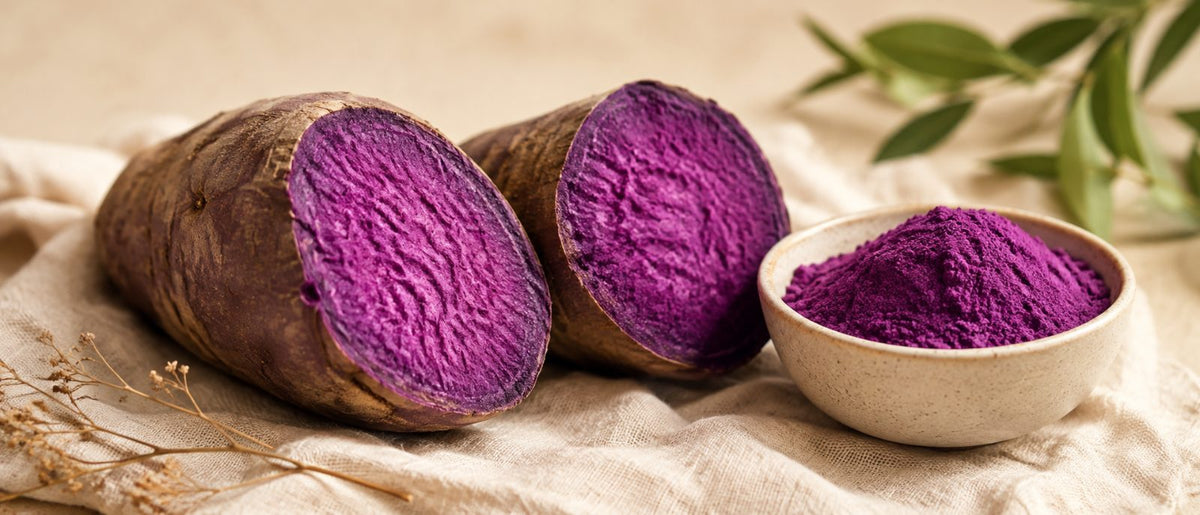
Ube, a tuber above all
Ube is a purple-fleshed yam. Like most tubers, it is made up mainly of complex carbohydrates, with fibre, a little vitamins and minerals, and very little fat. Its purple colour comes from natural pigments, the anthocyanins.
Raw, ube is not sweet. The «dessert» side we associate with it comes from the sugar added in recipes, not from the yam itself.
Nutritional values: fresh and powdered.
| Nutrient | Fresh ube | Ube powder |
|---|---|---|
| Energy | ≈ 120 kcal | ≈ 350 kcal |
| Carbohydrates | ≈ 27 g | ≈ 80 g |
| of which sugars | ≈ 1 g | ≈ 3 g |
| Fibre | ≈ 4 g | ≈ 10 g |
| Protein | ≈ 1.5 g | ≈ 4 g |
| Fat | ≈ 0.2 g | ≈ 0.5 g |
Fresh ube
Ube powder
How to read these figures
These values are given per 100 g and as an indication: they vary with variety, growing and drying. The powder shows higher figures because it is concentrated: the water has been removed. But you use very little at a time.
A real serving of powder for a latte is about 5 g (two teaspoons). At that dose, the calorie intake stays modest: most of a latte's energy comes from the milk and the sweetener, not from the ube.
The qualities of ube
Ube has several interesting strengths as part of a varied diet. It provides fibre, contains plant pigments (the anthocyanins, also found in blueberry or red cabbage), and lets you add colour and variety to your recipes without colouring.
It is also a naturally vegan ingredient, gluten-free and lactose-free in its pure state, which makes it easy to fit into many diets.
- Mostly complex carbohydrates and fibre, little fat.
- Not sweet raw: the sugar comes from the recipes.
- Natural pigments, the anthocyanins, behind the purple.
- Naturally vegan, gluten-free and lactose-free.
What we can say, and what we won't
You will sometimes read that ube has many virtues. To be honest, we stay cautious: ube is an interesting and tasty food, but we make no medical claims about it. It is enjoyed for its taste, its colour and its place in a balanced diet, not as a remedy.
See ube's anthocyanins, ube and caffeine, or diets and allergens.
A simple, honest ingredient.
Our 100% Kinampay ube powder is just purple yam: no added sugar, no additives. It's up to you to build indulgent, balanced recipes.
Your questions: ube nutrition.
How many calories are in ube?
Around 120 kcal per 100 g of fresh ube, and more for the powder as it is concentrated. But a serving of powder for a latte is small, about 5 g.
Is ube sweet?
No, not raw. Ube contains very little sugar. The sweet taste of ube desserts comes from the sugar added in recipes.
Does ube contain fibre?
Yes, like most tubers. It is one of its strengths as part of a varied diet.
Is ube good for you?
Ube is an interesting and tasty food, rich in complex carbohydrates and fibre. We stay cautious and make no medical claims about it: it is enjoyed for its taste and its place in a balanced diet.
Does the powder have the same values as fresh ube?
The powder's figures are higher per 100 g because the water has been removed. Related to a real serving, the intake stays modest.